
Equestrian Academy of Versailles
The Equestrian Academy of Versailles (Academie Equestre Nationale du Domaine de Versailles) is a performing arts institution and equestrian school inside the Grande Ecurie (Great Stables) at the Palace of Versailles. Bartabas, the equestrian artist and founder, created the Academy in 2003 as a place where Haute Ecole dressage meets dance, fencing, singing, and traditional Kyudo.
What is the Equestrian Academy of Versailles?
The Equestrian Academy of Versailles occupies the Grande Ecurie, directly opposite the Palace of Versailles on the Place d'Armes. Bartabas established the Academy in 2003 after the Palace of Versailles returned the Grande Ecurie to its original equestrian function. The Academy operates as both a higher education institution and a performing arts company, a hybrid Bartabas describes as a "company-school."
Rider-artists train in five disciplines: Haute Ecole dressage, fencing, dancing, singing, and traditional Kyudo (Japanese archery). Bartabas treats horsemanship as an art form, not a sport. He has described the project as "a creative laboratory, where the notion of collective work is strongly defended" and where "there can be no transmission of equestrian knowledge without the development of an artistic sensibility." Riders and horses work together daily in a curriculum that develops artistic expression alongside technical riding skill.
The Academy also stages original productions at the Grand Palais in Paris, the Saint-Ouen Abbey in Rouen, and the Ancient Theater of Fourviere. Past productions include Le Sacre de Stravinsky, Mozart's Requiem, and Metamorphosis.
Each weekend, the Academy hosts a public performance followed by a self-guided tour of the stables. The show is how most visitors encounter the Academy's work.
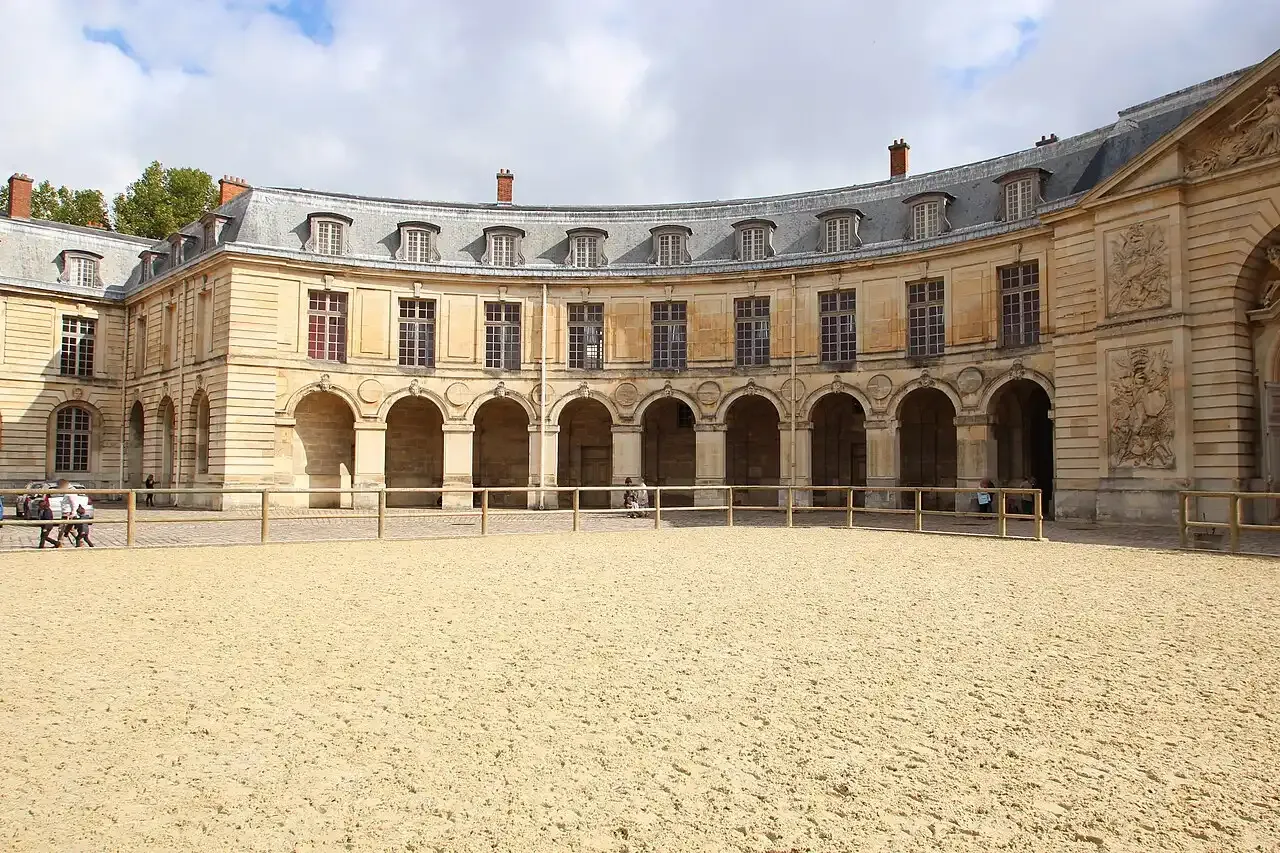
Main photo: “Grande Écurie de Versailles le 19 septembre 2015 - 11” by Lionel Allorge.
What happens during La Voie de l'Ecuyere?
La Voie de l'Ecuyere, the Academy's signature repertoire show, runs for about one hour and presents a dozen scenes of equestrian artistry. Bartabas choreographs the performance, and it evolves over time as riders and horses develop new skills and refine existing ones.
The show opens with the Lusitano carousel, a formation of Lusitano horses moving in synchronized patterns across the golden sand arena. Sorraia horses appear with long reins in a separate scene, a technique that lets the rider guide the horse from a distance. Riders fence on horseback in a scene drawn from the martial tradition of the Grande Ecurie. The performance closes with equestrian improvisations set to compositions by Johann Sebastian Bach, where riders respond to the music in real time.
Each scene highlights a different equestrian discipline. The show stays faithful to Bartabas's original creation, but individual scenes evolve as riders gain experience and new horses join the troupe. You sit meters from the sand arena, close enough that the interaction between horse and rider feels immediate.
After the final scene, spectators leave the tiered seating area and walk through the stables on a self-guided tour. The tour takes 20 to 30 minutes. You see the Lusitano and Sorraia horses in their stalls, watch the daily routines of the stable, and examine the restoration work on the building.
Where does the equestrian show take place?
Jules Hardouin-Mansart, the architect who designed the Grande Ecurie for Louis XIV, completed the building between 1679 and 1682. The Grande Ecurie and its twin, the Petite Ecurie (Small Stables), sit on either side of the Avenue de Paris at the edge of the Place d'Armes. At their peak during the 18th century, the royal stables housed over 2,000 horses and employed 1,500 men, including squires, blacksmiths, saddlers, and horse surgeons.
Patrick Bouchain, the architect who restored the space for the Academy, transformed the Manege Royal into a performance venue. The design draws from the Farnese Theatre in Parma, with Murano glass chandeliers and mirrors that reflect both horses and riders during performances, echoing the Palace's Hall of Mirrors. The golden sand track covers two-thirds of the arena surface. Opposite the track, tiered seating decorated with baskets accommodates the audience.
Bouchain rebuilt the stalls with attention to the horses' well-being. Vertical windows twist in a contemporary reference to unicorns and let natural light into the space. The stable layout meets the operational needs of a working equestrian facility while reflecting Bartabas's insistence on the well-being of every horse in the troupe.
The Grande Ecurie originally managed the king's saddle horses, animals trained for hunting and war, under the authority of the Grand Equerry of France. The Petite Ecurie across the avenue handled coach horses and ceremonial vehicles. Both buildings sit opposite the Palace, a placement that reflected the central role of horses in royal power during the Ancien Regime. Today the Grande Ecurie is a working stable and performance space where 17th-century royal architecture meets modern theatrical design.
Equestrian show tickets and how to book
Equestrian show tickets and how to book
The equestrian show at Versailles has two main ticket categories. Show-only tickets cost EUR 16 to EUR 35, depending on the seat category. All seating is unreserved, so arriving early gives you a wider selection.
The combo ticket costs EUR 59 and includes the equestrian show plus entry to the Palace of Versailles, the Estate of Trianon, temporary exhibitions, the Gallery of Coaches, the Gardens, and the Park. A good option if you plan to spend a full day at Versailles and want to catch the show too.
Visitors can book Versailles Palace tickets through our platform, which covers the equestrian show alongside other entry options for the main estate. Book in advance, especially for Saturday evening and Sunday afternoon performances when demand peaks.
When are the equestrian shows at Versailles?
The Academy performs on a regular weekly schedule:
- Saturdays at 6:00 pm
- Sundays at 3:00 pm
- Wednesdays at 3:00 pm (during school holidays in Ile-de-France only)
Wednesday performances follow the French school holiday calendar for the Ile-de-France region, so availability changes throughout the year. The Ile-de-France academic calendar includes two-week breaks in October, December, February, and April, plus the summer break from July through August. Check exact dates before planning a midweek visit.
Saturday evenings feel different from the daytime Sunday shows. As daylight fades through the arena's windows, the Murano glass chandeliers and mirrors sharpen the lighting contrast. Many visitors choose the 6:00 pm slot for that effect.
Plan around the best time to visit Versailles Palace if you want to combine the equestrian show with a tour of the main estate. The Palace is closed on Mondays but open Tuesday through Sunday from 9:00 am to 5:30 pm.
What should you know before visiting the Equestrian Academy?
- Arrive early. Seating is unreserved, so getting to the Grande Ecurie 20 to 30 minutes before showtime lets you pick a spot with a clear view of the entire sand track.
- Combine with the Palace. The Grande Ecurie sits about 8 minutes on foot from the Palace, on the town side of the Place d'Armes. The combo ticket (EUR 59) covers both the show and full Palace estate access. Check the map and entrances page for orientation.
- Stay for the stable tour. The self-guided tour after the show is included in every ticket. You walk through the stalls and see the Lusitano and Sorraia horses that just performed.
- Check the Wednesday schedule. Wednesday shows run only during Ile-de-France school holidays. Confirm dates before planning a midweek visit.
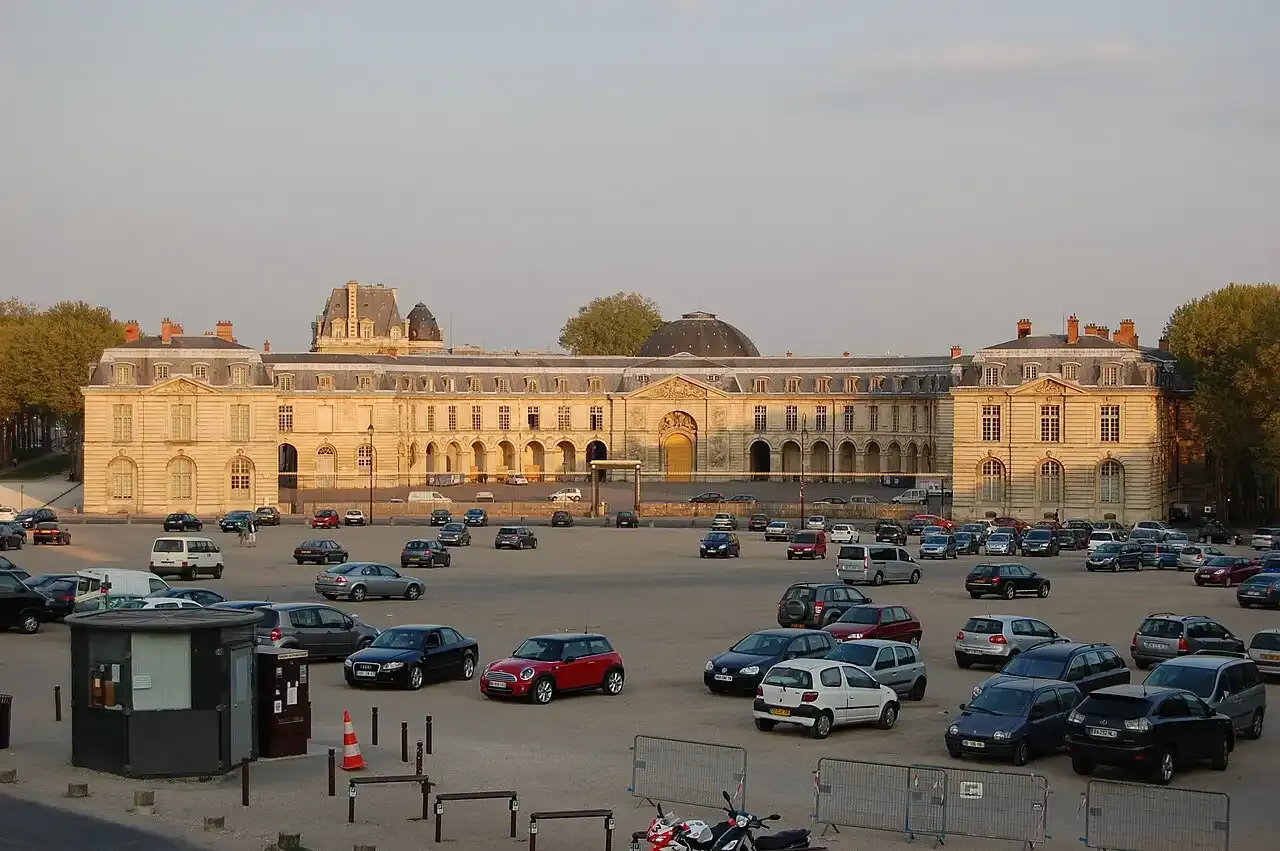
- Parking. Park at the parade ground near the Grande Ecurie. For train and bus options, see our getting to Versailles Palace page.
- Photography. The Grande Ecurie interior and stables photograph well before and after the show. Flash photography is not allowed during the performance, as it can startle the horses and endanger the riders. Check current rules at the door for other restrictions.
How to get to the Grande Ecurie
The Grande Ecurie stands on the Place d'Armes in Versailles, directly opposite the main entrance to the Palace of Versailles. The address is the Royal Riding School, Grande Ecurie, Place d'Armes, 78000 Versailles (coordinates: 48.8039, 2.1283).
From the Palace, walk about 8 minutes across the Place d'Armes toward the town. The Grande Ecurie is the large semicircular building to the north of the Avenue de Paris. From central Paris, take the RER C to Versailles Rive Gauche station, then walk 15 minutes to the Palace area. For more transport options, see our getting to Versailles Palace page.
Park at the parade ground next to the Grande Ecurie.