
Versailles Marble Courtyard
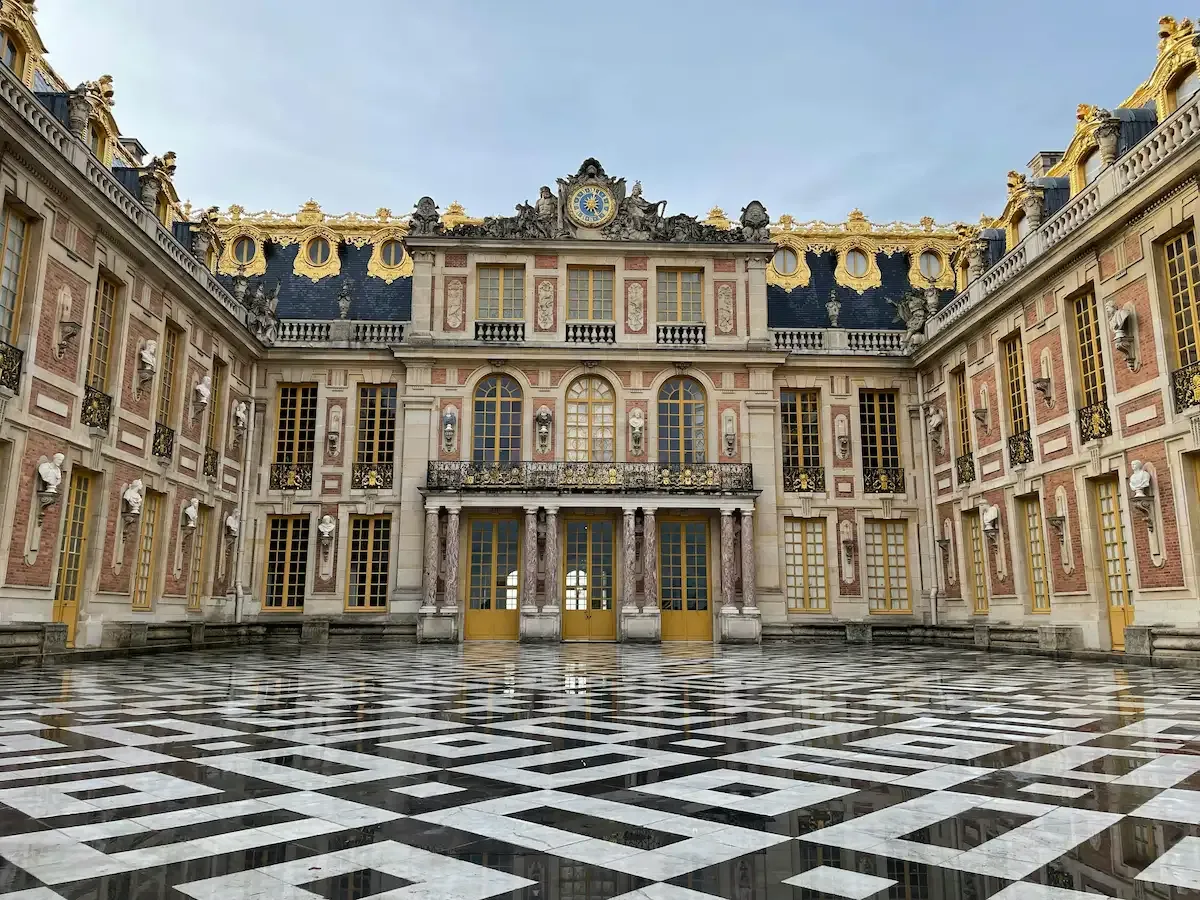
The Marble Courtyard (Cour de Marbre) is the oldest surviving part of the Palace of Versailles (Chateau de Versailles), built on the site where Louis XIII laid foundations for a hunting lodge in 1623. Louis XIV, the Sun King, preserved this narrow U-shaped space when he expanded Versailles, and its original facade of red brick, white limestone, and grey slate still frames a black-and-white marble floor.
Support when you need it
Customer support to help you with everything you need from 8:00 to 18:00.
Fast and online booking
Select your ticket for your needs and preferences and avoid the lines booking here.
Top attraction in Paris
Explore the Versailles Palace to see the royal architecture and the historical evolution of the French monarchy.
What is the Marble Courtyard at Versailles?
What is the Marble Courtyard at Versailles?
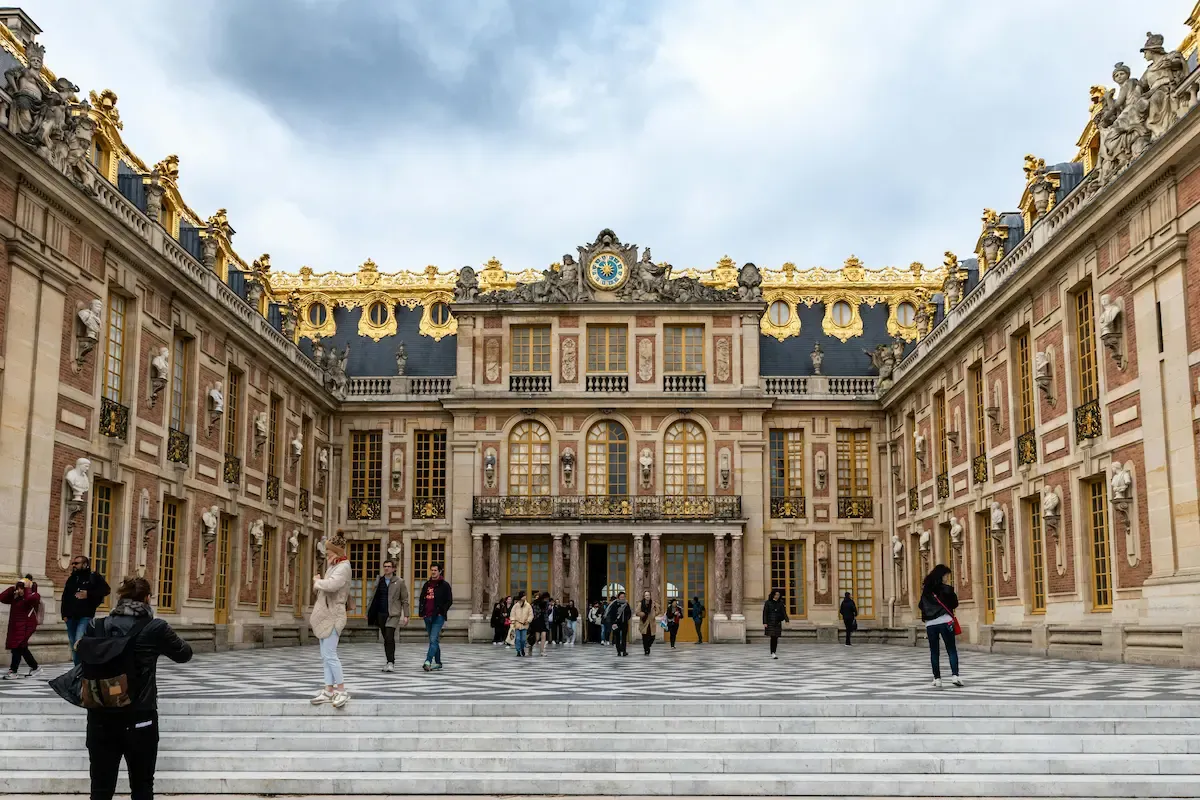
The Marble Courtyard is the innermost and smallest of the three courtyards that form the eastern approach to the Palace of Versailles. Visitors pass through the Ministers’ Courtyard (Cour des Ministres), enter the Royal Courtyard (Cour Royale), and then climb five steps to reach the Marble Courtyard at the highest point. The courtyards narrow and rise as you approach the palace. Under Louis XIV, fewer people could enter each successive space.
The courtyard sits at the center of the original building that Louis XIII commissioned in the 1630s. Louis XIV expanded Versailles into a full royal residence in the 1660s but preserved his father’s courtyard facade. He left a 17th-century brick-and-stone hunting lodge at the center of a Baroque palace with over 2,300 rooms.
History of the Marble Courtyard
The Marble Courtyard did not begin as a courtyard at all. Its history spans four distinct construction phases over a period of nearly 60 years, each overseen by a different architect serving a different king.
From hunting lodge to royal palace
Louis XIII purchased land in Versailles in 1623 and built a hunting lodge on a wooded hill 19 kilometers west of Paris. His courtier Francois de Bassompierre dismissed the site as a place that "would not inspire vanity in even the simplest gentleman." Between 1631 and 1634, architect Philibert Le Roy replaced the original lodge with a small chateau for Louis XIII. The building used a traditional Ile-de-France style: red Flemish brick walls, white limestone quoins and window frames, and a grey slate roof. Louis XIII forbade his queen, Anne of Austria, from staying overnight at Versailles, reserving it as his private retreat.
The chateau remained unchanged until 17 August 1661, when the young Louis XIV attended a lavish party at Nicolas Fouquet's Chateau de Vaux-le-Vicomme. The opulence of Fouquet's estate, created by architect Louis Le Vau, gardener Andre Le Notre, and painter Charles Le Brun, impressed and provoked the king. He imprisoned Fouquet within weeks and hired all three artists for his own projects at Versailles.
Architecture and design of the Marble Courtyard
The Marble Courtyard measures roughly 35 meters across and forms a tight U-shape enclosed on three sides by the original chateau wings. The fourth side, facing east toward the Royal Courtyard, is open but elevated by five stone steps that physically separate the Marble Courtyard from the more public spaces beyond.
The courtyard walls use three materials: red Flemish brick for the surfaces, white Ile-de-France limestone for the window surrounds, pilasters, and decorative trim, and grey Ardoise slate for the mansard roof. Gold leaf covers the balcony railings, clock surrounds, and dormer window pediments. This color scheme of red, white, grey, and gold predates the palace's later Baroque additions. Louis XIII's architects established it in the 1630s.
The floor is paved entirely in marble, arranged in a geometric checkerboard pattern of black and white tiles, which gives the courtyard its name. This paving replaced an earlier cobblestone surface during Louis XIV's reign and served both decorative and practical purposes: marble cleaned better than stone and reflected light into the ground-floor rooms.
What marble was used in the courtyard?
Builders of the Palace of Versailles used marble from quarries across France and Italy. The palace complex includes Languedoc red marble from the Pyrenees, white Carrara marble from Tuscany, and Belgian black marble for contrast elements. The Grand Trianon, built by Hardouin-Mansart in 1687, was clad so extensively in marble that it earned the name "Marble Trianon" (Trianon de Marbre).
The courtyard's black-and-white floor belongs to this same tradition of marble use at Versailles. For the Bourbon kings, marble signified royal status and permanence.
What to see at the Marble Courtyard
Visitors often cross the Marble Courtyard without stopping, focused on the state apartments inside. Pause here.
- The marble floor pattern. The black-and-white checkerboard extends across the entire courtyard, visible from the top of the five steps. The pattern is geometric and regular, and the marble tiles show visible wear from centuries of foot traffic, particularly near the central entrance.
- The material contrasts. The surrounding walls of red brick, white stone, and grey slate create a color palette different from the golden limestone facades of the garden side. These are the oldest visible surfaces of the palace, dating to the 1630s.
- The gilded balconies and clock. Above the central entrance, a gilded iron balcony projects from the first floor. This is the exterior face of the King's bedchamber. Above it, a clock on the facade marks the hours as it has since Louis XIV's time.
- The east-west axis. The palace's primary axis runs through the center of the Marble Courtyard, through the King's bedchamber, through the Hall of Mirrors, and out into the gardens along the Grand Canal. A visitor standing at the courtyard's center faces Paris to one side and the garden entrance to the other. Louis XIV aligned the axis with the rising and setting sun to express his identification with it.
- The elevation. The Marble Courtyard sits slightly higher than the Royal Courtyard. Each successive courtyard rises in elevation and falls in the number of people allowed to enter. Only those with specific court functions could reach the Marble Courtyard.

The King's bedchamber balcony
The central window and balcony directly above the Marble Courtyard belong to the King's bedchamber (Chambre du Roi). The room sits at the geometric center of the palace, aligned along the east-west axis. Louis XIV rose each morning facing east, as the sun does.
The bedchamber was the stage for two daily ceremonies that defined court life at Versailles: the lever (rising) and the coucher (retiring). Courtiers gathered in the adjoining rooms to witness the king's morning and evening rituals, and from the balcony above, the king could see anyone arriving or departing through the Marble Courtyard below.
The Marble Courtyard in French history
On 5 October 1789, a crowd of several thousand men and women marched from the markets of Paris to Versailles to protest bread shortages. They entered the courtyards, confronted the royal guard, and demanded that King Louis XVI and Queen Marie Antoinette address the crisis.
The next morning, 6 October, the crowd forced the royal family to leave Versailles for Paris. The family crossed the Marble Courtyard for the last time as reigning monarchs. Their departure ended Versailles as the seat of French government, a role the palace had held since Louis XIV moved his court there in 1682.
After the Revolution, the Convention ordered the palace's contents sold at auction. Between August 1793 and August 1794, the furnishings, mirrors, and kitchen equipment were sold in 17,000 lots. The building itself survived, and the Marble Courtyard's 17th-century architectural fabric survives.
The restoration teams at Versailles have returned much of the palace to its historical appearance, and the courtyard's polychrome facade of brick, stone, and slate stands today much as it did when Louis XIV chose to preserve it.
How to visit the Marble Courtyard
The Marble Courtyard is part of the standard palace visit at Versailles. You don't need a separate ticket. Visitors reach the courtyard by following these steps:
- Enter through the Main Gate (Grille d'Honneur) on the Place d'Armes.
- Pass the security checkpoint and proceed to Entrance A (for individual visitors with tickets).
- Walk through the Dufour Pavilion into the Royal Courtyard.
- Climb the five stone steps on the left to enter the Marble Courtyard.
The palace opens Tuesday through Sunday. High season hours (April to October) run from 9:00 am to 6:30 pm. Low season hours (November to March) run from 9:00 am to 5:30 pm. The palace is closed every Monday.
From April to October, book online in advance to guarantee entry. During the low season, tickets are also available at the on-site ticket office on the left side of the Ministers' Wing South.
Best time to visit and photography tips
Visitor data shows that Tuesdays are the busiest day at Versailles, with crowds peaking around noon. The quietest weekday is Thursday, with roughly 40% fewer visitors during midday hours compared to Tuesday. Sunday afternoons draw the highest weekend crowds.
For the best experience at the Marble Courtyard, arrive at 9:00 am when the palace opens. At this time, the east-facing courtyard receives direct morning sunlight. The warm light on the brick-and-stone facade makes the material contrasts sharper. Morning crowds are lower than midday or afternoon crowds on any day.
Photography works best from two positions: standing at the base of the five steps looking west into the courtyard captures the full U-shaped facade, while standing inside the courtyard looking east frames the Royal Courtyard and the distant Place d'Armes through the opening. The gilded balcony and clock above catch the morning light.
For orientation on the grounds, the map and entrances guide clarifies the relationship between the three courtyards and the garden entrances. Visitors planning a full day may also want to explore the Versailles fountains, which run during the Musical Fountains shows from April to October.