
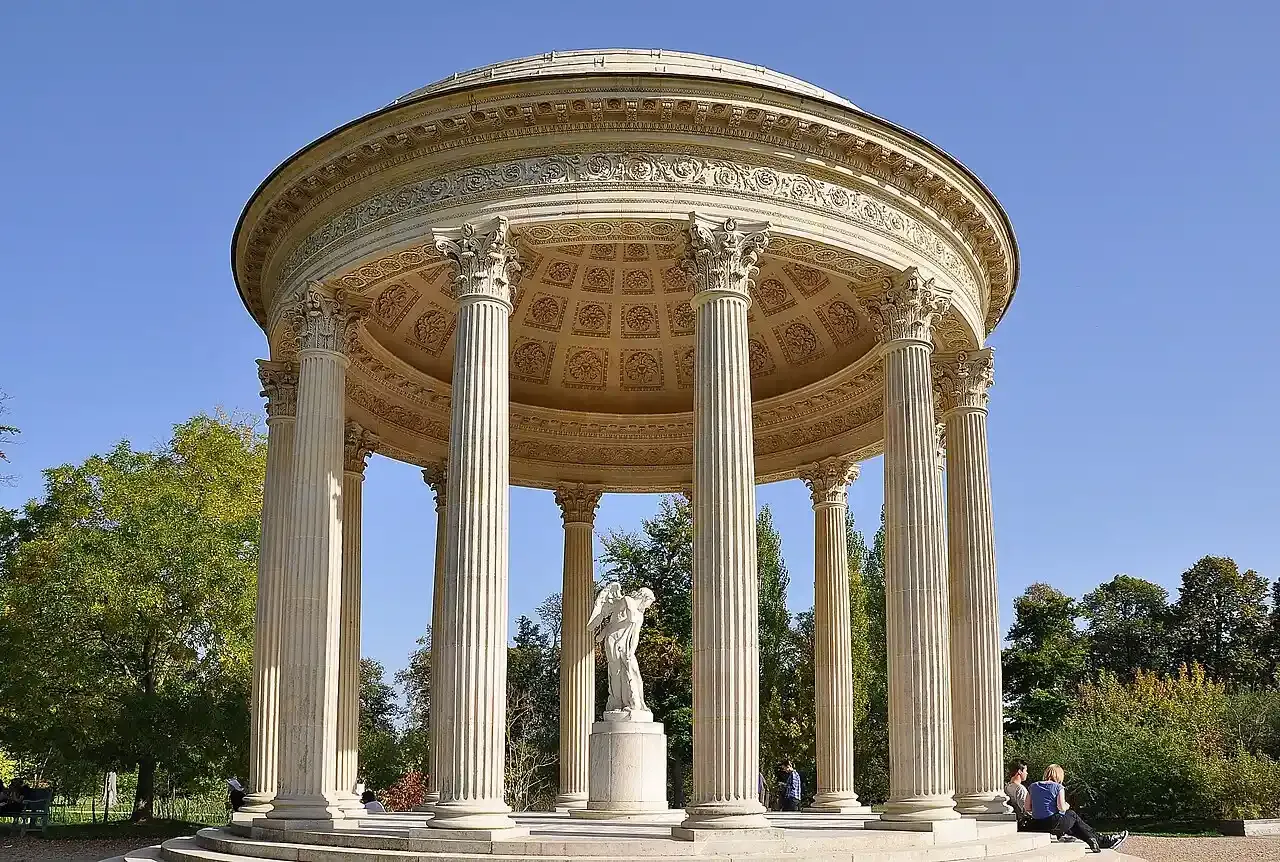
Temple of Love at Versailles
The Temple of Love (Temple de l'Amour) is a neoclassical garden folly in the English Garden of the Petit Trianon at the Palace of Versailles (Chateau de Versailles). Built in 1778 by architect Richard Mique for Queen Marie Antoinette, the structure sits on a small island in the garden's river.
Built for Marie Antoinette in 1778
A neoclassical open-air pavilion with 12 Corinthian columns on a marble island in the English Garden of the Petit Trianon, designed by architect Richard Mique.
Trianon Estate ticket required
Access requires a Trianon Estate or full Passport ticket purchased online. The estate opens at midday and closes at 6:30 pm (April–October). Closed Mondays.
Romantic landmark and photo spot
The Cupid statue by Mouchy stands at the centre of the colonnade. Couples use the Temple for proposals and photography, with the best light between 6:00 and 7:30 pm in summer.
What is the Temple of Love at Versailles?
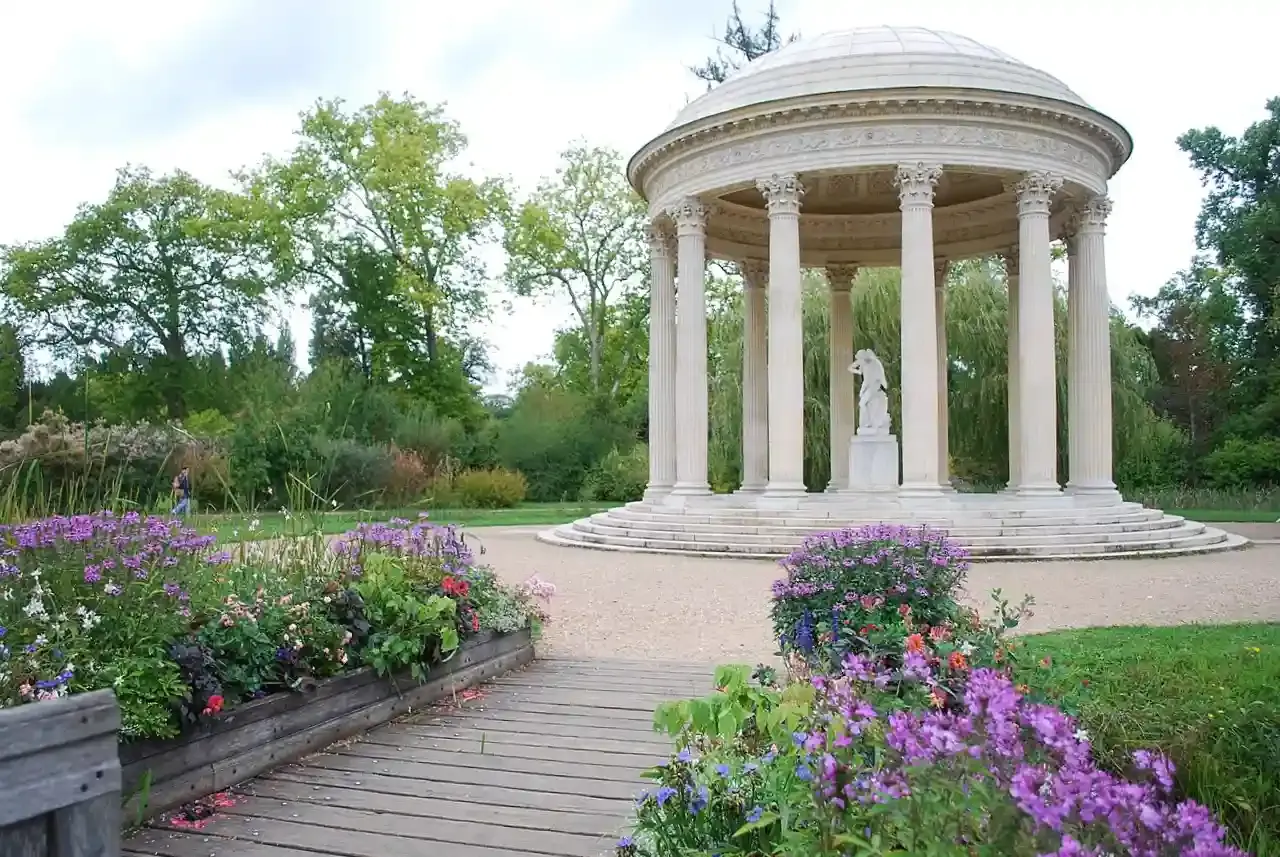
What is the Temple of Love at Versailles?
The Temple of Love (Temple de l'Amour) is an open-air neoclassical pavilion set on a small island in the English Garden at the Petit Trianon estate. Queen Marie Antoinette commissioned the structure in 1777 as one of two ornamental buildings in her private garden. The other is the Belvedere.
Twelve Corinthian columns rise from a circular marble platform and support a domed cupola. A statue of Cupid stands at the centre. Unlike the formal French gardens surrounding the main Palace of Versailles (Chateau de Versailles), the English Garden follows a naturalistic Anglo-Oriental design that Marie Antoinette selected to replace the botanical gardens of Louis XV.
Photo: “Temple of Love Versailles in Summer” by Mkonikkara
Who built the Temple of Love and when?
Richard Mique, the royal architect, designed the Temple of Love in 1777 under a direct commission from Marie Antoinette. On 5 May 1777, Mique presented the queen with a scale model made of wood, plaster, and wax, crafted to his instructions by sculptor Joseph Deschamps. Marie Antoinette approved the plans without changes, a departure from her usual practice of requesting modifications.
Marie Antoinette took possession of the Petit Trianon in 1774 and replaced Louis XV's botanical gardens with an Anglo-Oriental garden in the English landscape style. She limited new buildings to two ornamental structures: the Temple of Love and the Belvedere, both designed by Mique.
Construction started after the queen's approval and finished in July 1778. Guiard laid the masonry. The project took a little over a year from design to completion.
The Temple survived the French Revolution intact, though revolutionaries removed the centrepiece statue. In 2006, the Chateau de Versailles restored the Temple to its eighteenth-century condition.
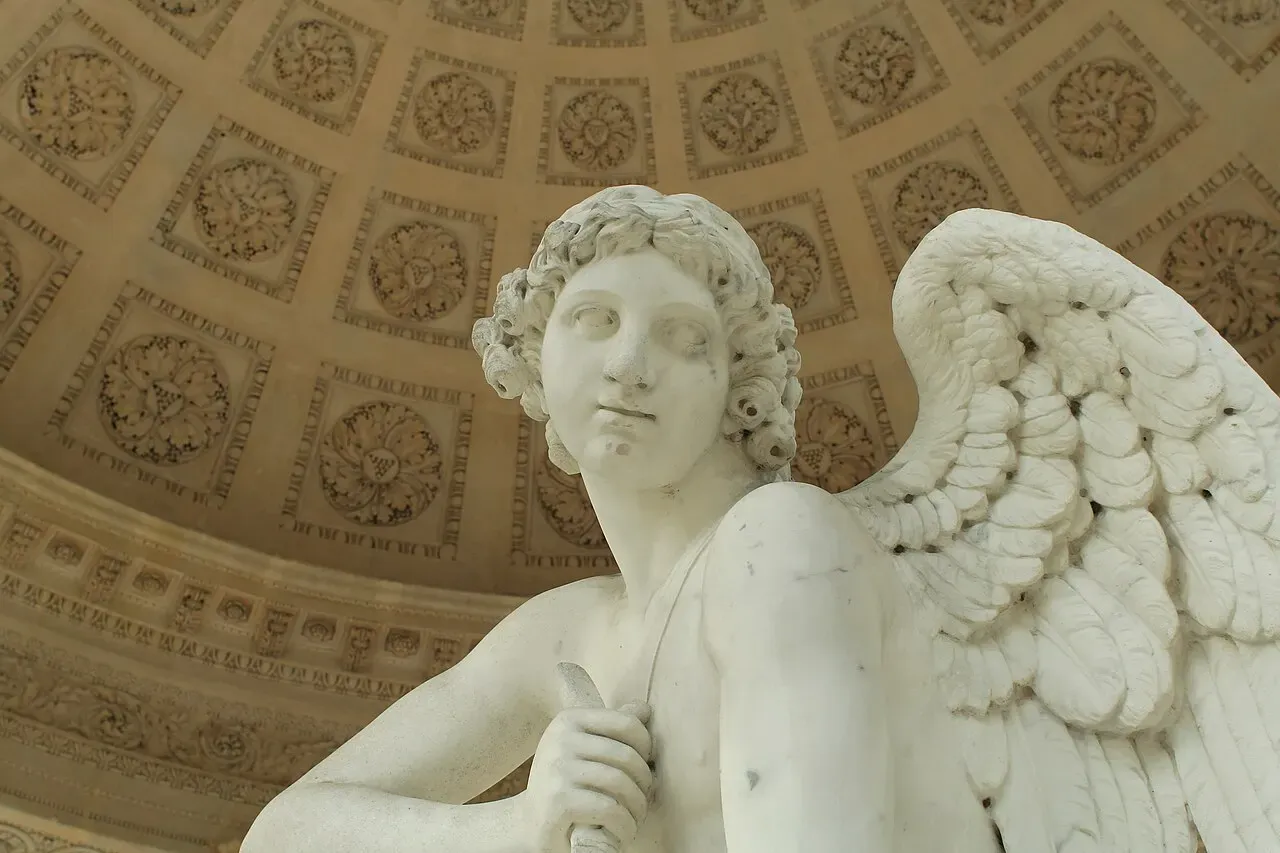
What is the statue inside the Temple of Love?
The centrepiece of the Temple is a marble statue of Cupid fashioning his bow from the club of Hercules. Sculptor Louis-Philippe Mouchy carved this copy of an original by Edme Bouchardon from 1750. Bouchardon carved the original for the Hercules Room at Versailles, but the court sent it to the Chateau de Choisy in 1752, where few people saw it.
Marie Antoinette rejected the sculpture Deschamps had proposed for the Temple. She had the Bouchardon original transferred to the Louvre, where Mouchy could study it and produce a faithful reproduction. Mouchy placed this copy on the Temple's central pedestal.
During the French Revolution, officials removed Mouchy's copy and sent it to the Chateau de Saint-Cloud. The Temple stood empty for more than two decades. The Bourbon Restoration government returned the statue in 1816.
Photo: “Petit Trianon, temple de l'Amour, Amour se taillant un arc dans la massue d'Hercule, Louis-Philippe Mouchy” by Coyau
Architecture of the Temple of Love
The Temple stands atop a circular platform with seven steps, visible from across the English Garden's river. Twelve Corinthian columns arranged in a circle support a low-profile cupola made of Conflans limestone, covered with sheets of lead and painted to resemble wood. The lead protected the stone while keeping the appearance of a lighter structure.
Beneath the cupola, sculptor Joseph Deschamps carved a centrepiece about two metres in diameter. The carving combines a quiver, arrows, and flaming embers with roses and olive branches, all symbols of love and peace. Sculpted caissons and rosettes radiate outward from this central panel across the underside of the dome.
The entablature connecting the columns to the cupola carries an architrave with rosettes and Arabesque scrolls carved into the soffit on both interior and exterior faces, joined by a composite cornice. At ground level, marble craftsman Le Prince laid the floor in three types of marble: veined white, Languedoc red, and Flanders. The three marbles contrast with the pale columns above.
What else can you see in the English Garden?
The Temple of Love is one of three principal follies in the English Garden, all designed by Richard Mique and all completed within a five-year span. Winding paths lined with mature trees connect all three structures.
The Belvedere
Completed in 1781, three years after the Temple, this octagonal pavilion sits on a small mound above the lake. Low-relief sculptures of the four seasons crown four windows, and four patio doors open to an interior with mural paintings by Sebastien-Francois Le Riche. Lagrenee painted the ceiling with cherubs in a clear blue sky, and a marble mosaic covers the floor. Marie Antoinette used the Belvedere as a summer lounge. Openings on all sides let air circulate through the interior.
How to visit the Temple of Love
The Temple of Love sits within the Trianon Estate, a ticketed section of the Versailles grounds separate from the free public gardens near the main Palace. Access requires either a Trianon Estate ticket or the full Passport ticket, which covers the Palace, the gardens, and the Trianon Estate in a single entry.
- Hours: The Trianon Estate opens at midday and closes at 6:30 pm during high season (April through October). Hours are more restricted during the low season. The main Palace operates on different hours (Tuesday through Sunday, 9:00 am to 5:30 pm), so plan accordingly.
- Closed: Mondays year-round.
- Tickets: Must be purchased online in advance. Check the Versailles opening hours page for the current calendar, and purchase Versailles tickets before your visit.
- Access: The Temple is outdoors and open-air. Visitors walk up to the structure freely within the Trianon Estate. There is no interior room or enclosed space.
Use the Versailles map and entrances to identify the entrance closest to the Trianon Estate.
Photography and the Temple as a romantic destination
The colonnade rises from an island framed by mature trees, with the Cupid statue visible at the centre. Couples use the Temple for proposals and wedding photographs, and have done so long before social media.
For photography, shoot from across the river to capture the full colonnade reflected in the water with surrounding trees framing the structure. Inside the Temple, point upward into the sculpted cupola to photograph the Deschamps rosettes and natural light between the columns. The warmest light on the limestone falls between 6:00 and 7:30 pm in summer.
Professional photography and commercial shoots at Versailles require a permit from the estate administration. Casual visitor photography with personal cameras or phones is unrestricted throughout the Trianon Estate.
Main photo: “Temple de l'Amour de Versailles” by Moonik